-
Business Design
-
Business Design is the discipline of designing the structure, operation, and expression of a company.
Most businesses are not deliberately designed. Strategy, organisational systems, and brand expression often develop independently, shaped by circumstance rather than intention. Over time this produces organisations that are difficult to manage internally and unclear to the market.
Business Design takes a different approach.
It treats the company as a system that can be intentionally constructed so that strategy, organisation, and expression reinforce one another.
When these elements are aligned, businesses become easier to lead, easier to operate, and easier to understand.
-
Designing the Company
-
Many organisations treat design as something applied late in the process through branding or marketing.
Business Design applies design thinking much earlier.
It focuses on designing the underlying architecture of the business itself. The goal is to create a coherent structure that guides how the organisation operates and how it presents itself to the world.
Rather than producing isolated outputs, Business Design creates systems that provide clarity over time.
-
The Three Layers of Business Design
-
Business Design operates across three interconnected layers.
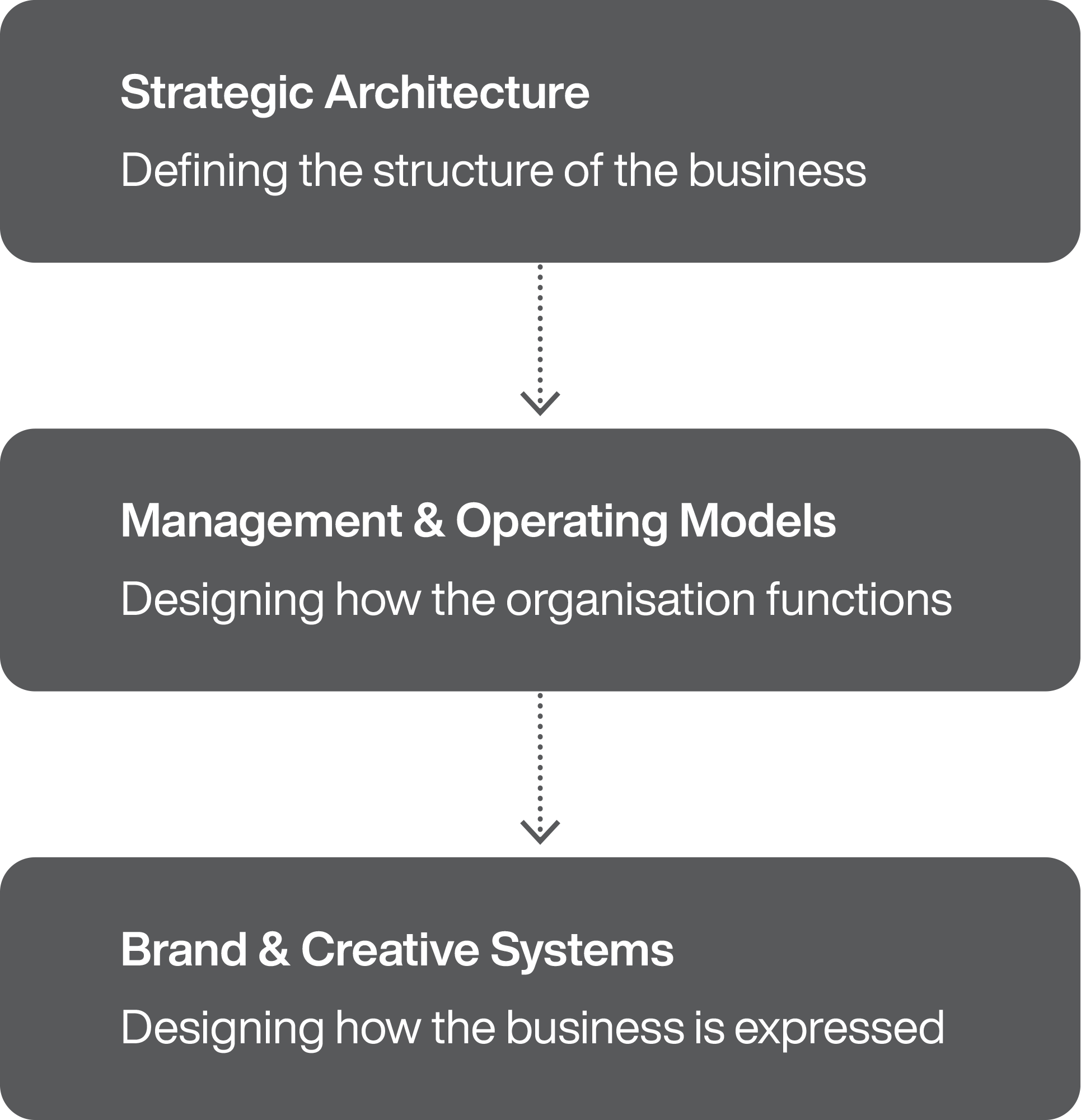
Strategic Architecture
Strategic Architecture defines the structural logic of the business.
It determines how the company positions itself within its market, how its products or services are structured, and how strategic decisions remain aligned over time.
This layer ensures that the organisation understands what it is building and why.
Management and Operating Models
Management and Operating Models define how the organisation functions internally.
This layer designs the systems that translate strategy into execution, including operating models, governance structures, decision frameworks, and organisational roles.
When this layer is clearly designed, the organisation becomes significantly easier to coordinate and scale.
Brand and Creative Systems
Brand and Creative Systems define how the business expresses itself externally.
This layer translates the internal structure of the organisation into identity systems, communication frameworks, product language, and customer experiences.
When expression reflects the structure of the business, the organisation becomes clearer and more recognisable in the market.
-
Business Design
-
Alignment Creates Coherence
-
These three layers form a continuum.
Strategy defines the structure of the business.
The operating model determines how the organisation functions.
Brand and creative systems express the organisation externally.When these layers are developed independently, companies become fragmented.
When they are designed together, the organisation becomes coherent.
This coherence allows strategy to translate into execution and communication with far greater clarity.
-
Business Design in Practice
-
The discipline of Business Design produces a set of structured artefacts that guide how the organisation operates and evolves.
These artefacts define the architecture of the business, including its strategic framework, operating systems, and design language.
Together they form a reference structure that leadership teams can use to maintain alignment as the organisation grows.
-
The Discipline of Business Design
-
Business Design positions design as a method for organising complexity within organisations.
It provides a structured way to develop businesses that are not only strategically sound, but also operationally coherent and clearly expressed.
Through this approach, companies become systems that are deliberately constructed rather than gradually improvised.
-
Relationship to the Practice
-
Callan + Associates is a design-led practice specialising in Business Design.
The practice applies this discipline through three capability areas:
These capabilities translate the concept of Business Design into practical frameworks that shape how organisations operate and evolve.